

Search visibility used to be measured on a familiar page: ten blue links, a position number, and a predictable path from query to click. That model still matters, but it no longer describes the whole journey. People now discover brands through AI answers, summaries, comparison tables, community discussions, product pages, and traditional results—often within the same research session.
For marketing teams, the practical challenge is not choosing between SEO and AI search. It is building one operating system that makes a brand easy to find, understand, trust, and recommend wherever a buyer asks a question. This guide explains how to create that system, measure it sensibly, and turn what you learn into a repeatable content workflow.
Visibility is becoming a portfolio, not a position
A ranking is a useful observation, but it is only one observation. A buyer may see your page in Google, encounter your company in an AI-generated answer, open a third-party review, and return later through a branded search. Each surface contributes context. Taken together, those appearances create the mental availability that helps a buyer remember and shortlist your brand.
This is why a modern visibility strategy needs a portfolio view. You want to know where your brand appears, which topics it is associated with, what sources influence the answer, and whether the description is accurate. You also need to see where competitors are present when you are absent. No single metric captures all of that, so the goal is a compact scorecard that guides action instead of producing more reporting noise.
Search journeys are fragmented by design
Different search experiences optimize for different user needs. A conventional results page makes it easy to compare destinations. An AI answer attempts to synthesize them. A product marketplace emphasizes availability and reviews. A social thread emphasizes lived experience. Strong content can participate in several of these environments, but only when its purpose, evidence, and structure are clear enough to travel.
Map the journey before deciding what to publish. Start with the questions a buyer asks while defining a problem, comparing approaches, evaluating vendors, and validating a final decision. Then identify the surfaces that appear for those questions. The result is a demand map grounded in real discovery behavior rather than a list of isolated keywords.
- Track important questions across Google, ChatGPT, Claude, Gemini, and Perplexity.
- Record whether your brand is mentioned, recommended, cited, or absent.
- Note which competitors and third-party sources appear consistently.
- Separate informational visibility from high-intent evaluation visibility.
Build the foundation before chasing mentions
AI systems do not remove the need for a strong website. They increase the value of clear information architecture, descriptive pages, credible evidence, and consistent brand language. If your own site is ambiguous about what you offer, who it is for, or how it differs, every downstream system has to guess. Those guesses are rarely as precise as the message your team intended.
The principles in Google Search Central’s helpful-content guidance remain a solid baseline: create for people, demonstrate real expertise, and satisfy the purpose that brought someone to the page. The same qualities also make passages easier for an answer engine to interpret and cite.
Begin with core entity clarity. Use the same product names, category language, and company description across important pages. Connect related topics with internal links. Give every key claim enough context to stand on its own. Add original examples, data, screenshots, or expert commentary wherever they materially improve the answer. These are not tricks for a particular algorithm; they are ways to reduce ambiguity.
Organize content around buyer questions
A topic cluster should feel like a useful path, not a pile of articles that happen to share a phrase. One page can define the problem, another can explain the process, and another can compare solutions. Supporting pages should answer narrower questions and link naturally to the broader guide. This structure helps readers move forward while making the relationship between subjects explicit.
Prioritize questions with both strategic relevance and evidence of demand. Search volume is one input, but it should not be the only one. Sales calls, support tickets, community posts, product usage, and competitor gaps often reveal questions that keyword tools understate. When several signals point to the same need, you have a strong candidate for content.
- What problem is the reader trying to solve right now?
- What must they understand before they can compare options?
- Which claims require evidence, examples, or a source?
- What useful next step should the reader be able to take?
- Which related page should they visit when their intent changes?
Measure presence, accuracy, and influence
Measurement should reveal what to do next. Start with a stable set of prompts that represent meaningful buyer questions. Run them on a consistent cadence, store the responses, and classify the outcome. A mention is different from a recommendation, and a recommendation is different from a cited recommendation. Keeping those distinctions visible prevents a flattering but unhelpful visibility percentage from becoming the whole strategy.
Accuracy deserves its own measure. A brand can appear often while being described with outdated positioning, missing an important capability, or being compared against the wrong category. Review recurring claims and flag material errors. The remedy may be a clearer product page, updated documentation, better third-party coverage, or a stronger explanation on an existing article.
Finally, measure influence. Identify the domains and pages that repeatedly shape answers for your tracked questions. Some will be sources you control; others will be publications, directories, communities, research, or customer reviews. The point is not to force every answer back to your website. It is to understand the information ecosystem around your category and improve your presence within it.
A practical visibility scorecard
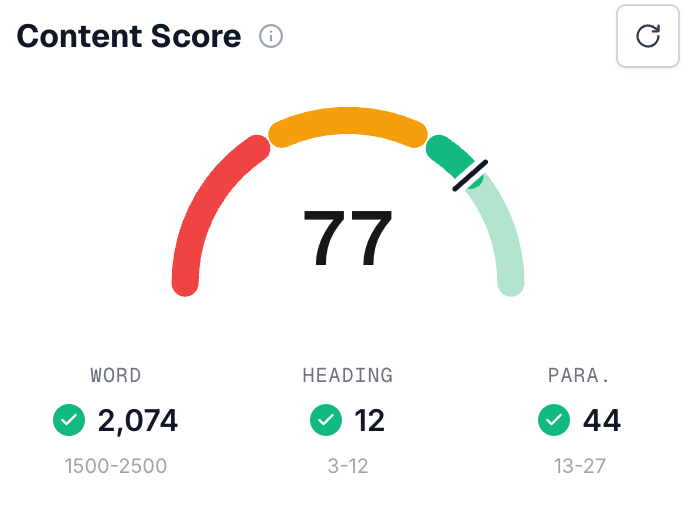
- Presence: the percentage of tracked answers that mention your brand.
- Recommendation: how often the brand is presented as a suitable choice.
- Citation: how often an answer links to or references content you own.
- Accuracy: whether important product and positioning statements are correct.
- Share of voice: your presence compared with a consistent competitor set.
Create content that can be understood in pieces
Long-form depth and answer-ready clarity are not opposites. A comprehensive article can still use direct section headings, concise opening answers, descriptive examples, and self-contained definitions. The reader gets a page that is easy to scan, while search systems get passages with enough context to interpret correctly. The best structure serves both without sounding mechanical.
Write the strongest answer before the supporting detail. If a section promises to explain how to measure AI visibility, its first paragraph should answer that question plainly. Follow with the reasoning, method, limitations, and examples. This pattern respects the reader’s time and makes the page useful even when someone arrives at a deep section from a search result or shared link.
The growth of products such as ChatGPT search reinforces the need for content that combines clarity with trustworthy sources. Link to primary evidence when it improves the answer, keep dates visible for time-sensitive claims, and update pages when the underlying facts change.
Optimize answer sections without flattening your voice
Templates can improve consistency, but they should not make every page sound interchangeable. Preserve a clear editorial point of view. Use the language your customers use, explain tradeoffs honestly, and include details that come from real experience. Distinctive information is more valuable than another generic summary of what already exists across the web.
Edit for retrieval after editing for meaning. Check whether pronouns have clear references, whether headings describe the actual section, and whether tables or lists have enough surrounding context. Replace vague claims with concrete language. Remove introductions that delay the answer. These changes improve readability first and machine interpretation second.
- Use descriptive headings that match the question answered in each section.
- Place a direct answer near the start, then add nuance and evidence.
- Keep examples specific enough to teach a repeatable method.
- Add internal links where a reader genuinely needs deeper context.
Turn insights into a weekly operating rhythm
A visibility program stalls when research, writing, optimization, and measurement live in separate queues. Build one workflow from opportunity to outcome. Each finding should have an owner, a proposed action, a target page, and a reason it matters. That action might be creating a new guide, refreshing a weak section, adding evidence, improving internal links, or correcting inconsistent positioning.
Run a short weekly review focused on movement and decisions. Look at new competitor appearances, lost mentions, recurring citation sources, and prompts with inaccurate answers. Choose a small number of actions that can ship. The purpose is not to explain every fluctuation; it is to create a steady feedback loop between what the market is asking and what your team publishes.
Then evaluate changes over a realistic window. Search and answer systems need time to discover, interpret, and reuse updated information. Keep an annotation log so the team can connect meaningful changes to published work without claiming causation too early. Over several cycles, patterns will show which content and distribution activities consistently improve visibility.
A simple cadence for a small team
- Monday: review visibility changes and select the highest-value opportunities.
- Tuesday and Wednesday: create or update the pages that address those gaps.
- Thursday: strengthen evidence, internal links, metadata, and distribution.
- Friday: publish, annotate the change, and set the next review date.
The goal is not to manufacture more content. It is to make every useful answer easier to discover, verify, and recommend.
Avoid the shortcuts that create reporting without progress
The fastest way to weaken the program is to optimize for a metric that has no relationship to a buyer decision. Thousands of low-value prompts can make a dashboard look comprehensive while hiding the questions that matter. Start narrow, choose prompts deliberately, and expand only when the additional coverage changes a decision your team can make.
Another common mistake is treating every missing mention as a content problem. Sometimes the real gap is product positioning, distribution, reputation, or third-party validation. Diagnose the source landscape before assigning another article. The best response may be clearer documentation, a customer story, original research, or outreach to a relevant publication.
- Do not publish near-duplicate pages for every wording variation of a question.
- Do not measure mentions without checking their context and accuracy.
- Do not copy an answer-engine response and call it original research.
- Do not ignore traditional search performance while testing new surfaces.
- Do not let dashboards replace conversations with customers and sales teams.
Build a system that compounds
Winning visibility across search is not a one-time optimization project. It is a learning system. You observe how buyers ask questions, understand which sources shape their answers, publish material that deserves to be used, and measure whether your presence becomes stronger and more accurate. Each cycle improves the next because the team is working from evidence rather than assumptions.
Start with a focused set of topics, a small scorecard, and a weekly decision rhythm. Make the website unambiguous. Create content with direct answers and real depth. Strengthen the wider source ecosystem around your brand. Over time, those habits make your company easier to discover across Google, AI search, and whatever interface comes next.